


Rough check
Purpose
Defined terms used in this document, but not defined herein, have the meaning as set out in the Tracr Participant Terms & Conditions. As part of the Tracr Services, Tracr may carry out automatic “matching” of rough diamond data uploaded by Participants on to the Tracr Platform. Where a rough diamond’s data, that has been provided by different Participants, has been “matched” using Tracr’s Services, Tracr may include a Tracr rough check (“Rough Check”) mark. The Rough Check mark may be presented against a diamond on the Tracr Platform which will indicate that information about the rough diamond, as uploaded and recorded by the Manufacturer, has been successfully matched by Tracr against information about a rough diamond, as uploaded and recorded by the Producer, within a given tolerance (as explained below). The Rough Check mark provides enhanced confidence that the data uploaded by the Manufacturer in relation to a rough diamond is consistent with the data originally uploaded by the Producer in relation to that rough diamond. The Rough Check mark will appear on the owner of the diamond’s private Tracr Platform inventory. See Figure 1.
Please note that a diamond can continue its journey on the Tracr Platform without a Rough Check mark (for example, where it is not possible to provide a match due to data quality issues).
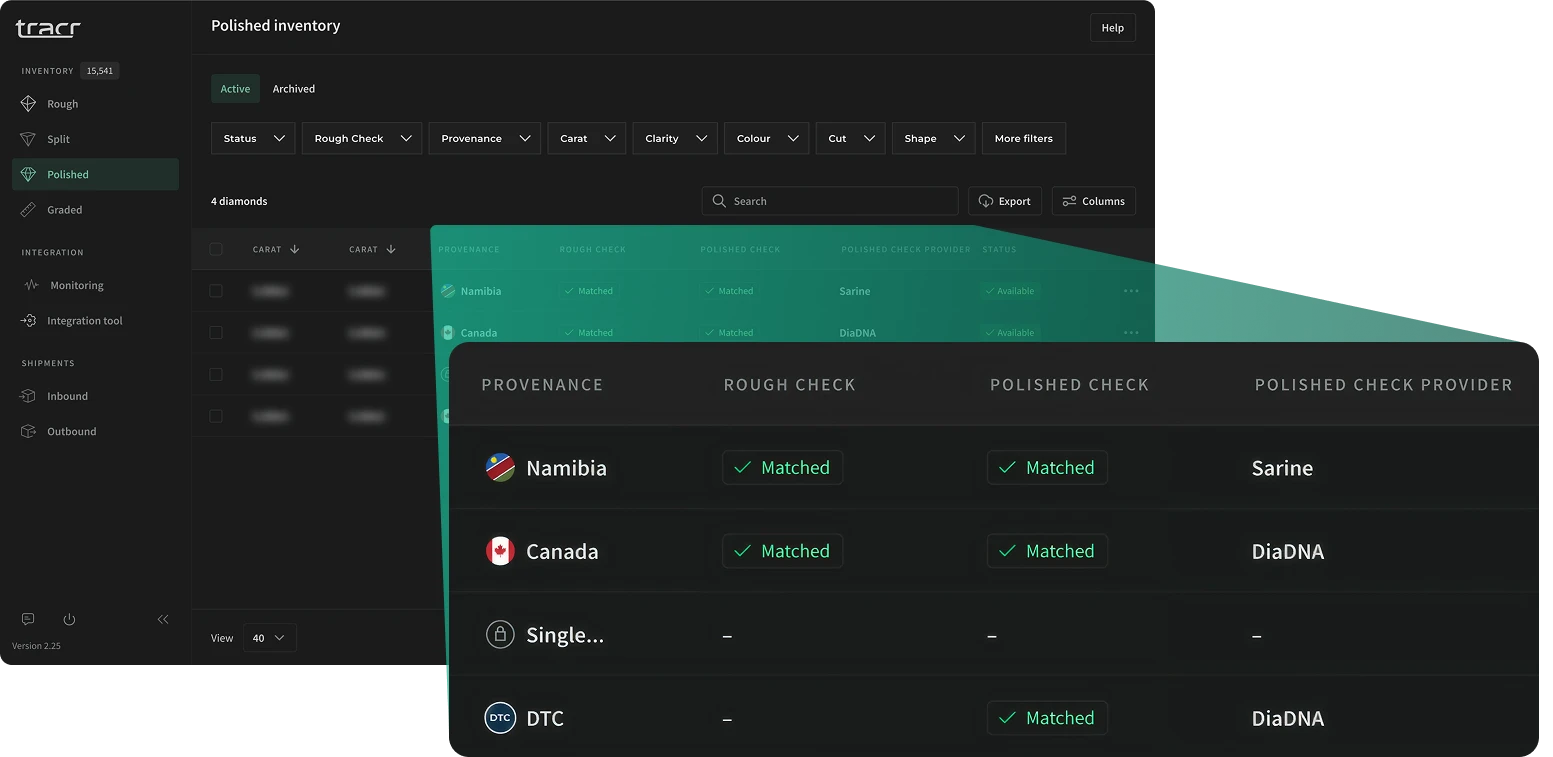
Fig 1: Examples of a Participant’s polished inventory with and without the Rough Check mark
How does diamond matching work?
Rough Check diamond matching leverages advanced machine learning algorithms to understand features and accurately identify and compare diamond characteristics between the information and scanned data of a rough diamond uploaded and recorded to the Tracr Platform at Manufacturer level and information and scan data of a rough diamond uploaded and recorded to the Tracr Platform at Producer level. The cornerstone of this process is the detailed scan of the surface of each diamond, which provides a unique digital fingerprint.
Rough Check matching primarily consists of:
- Filtering by Producer batch/lot/box number to provide a set of diamonds to be matched against the Manufacturer diamond. Where more than one diamond is provided, the algorithm will search the available diamonds to find the best match.
- Filtering by weight, and structural features to further reduce the search set. Carat measurement errors can occur due to inconsistency between Participant scanning machines or other factors such as machine calibration and location, and the algorithm adaptively allows for this by searching for candidate matches within a specified weight tolerance.
- Surface alignment checks how well two scans overlap geometrically, providing a clear measure of similarity. Usually, if the scans are generated with high-accuracy machines then a much better alignment is observed (see minimum scanning requirements below). Where a match is found within a given tolerance (as detailed below), the Rough Check mark is shown in the Manufacturer’s instance on the Tracr platform.
How often is the algorithm successful in finding a match?
One of the key metrics for assessing our matching success is the matching rate, which represents the number of diamonds successfully identified compared to the total number provided (“Matching Rate”). A match may not be possible in scenarios when the data provided by Participants is suboptimal. Factors such as significant weight discrepancies, physical alterations before scanning, or low- quality 3D scans can reduce confidence in a match, leading the match to fail (see further details below). Nonetheless, Tracr continually works to extend our capabilities to handle various edge cases and diverse scan formats. We also collaborate with our Participants to improve scan quality, thus increasing the chances of successful matches.
It is important to note that while Tracr will accept 3D scans in standard formats from any diamond scanner meeting the minimum scanning standards below, different types of scanners and their settings can affect the Matching Rate, and every stone, box or shipment has its own particularities.
Matching Rates are probabilistic and Tracr may observe different Matching Rates in the live environment. As a result, the figures given below should be considered as indicative and may be subject to change.
Matching Type
Matching Rate
Producer Rough
Manufacturer Rough
92% - 99% *
Minimum scanning standards
To ensure sufficient details to allow matching and identification, Tracr recommends that rough diamond STL scans contain a minimum vertex count of 300 vertices per scan which should be uniformly distributed across the entire surface of the diamond. While this will not guarantee a match, it will ensure maximum matching performance whereas providing less than 300 vertices will result in a degradation in Matching Rates. Scans containing higher than 300 vertices are also accepted, however, from our observation this does not result in any further improvement in Matching |Rate, and is entirely optional.
How confident is the match?
In addition to the Matching Rate, understanding the validity of the matches is crucial. Metrics such as recall and precision help determine the validity of matches identified by Tracr’s algorithms. Calculating these metrics accurately is limited by data availability, however we can give indications below based on the tests performed to date. Further results will be published as expanded test data becomes available to Tracr for a wider range of scanning types.
Confidence Levels
If your rough stone can be identified, how likely is it that our system will correctly identify it? (recall)
If we identify a rough stone as a match, how likely is it to be a correct match? (precision)
93%+ to 99%+ depending on scan types*
86%+ to 99%+ depending on scan types*
*Experiments conducted on a labelled sample of 497 rough stones using two commonly available industry scanning technologies. NB Some variation in confidence rates is also observed for different rough stone shapes (sawables, makeables and crystals).
What happens when the match fails
If the Tracr algorithm fails to find a rough scan from a Producer that matches the Manufacturer rough scan within the accepted tolerance then i) the Rough Check mark will not appear in the Manufacturer inventory screen (see Figure 1); and ii) in the event the shipment contains multiple countries of origin, single country will not be provided. Where a match fails, a new scan may be submitted by the Participant for matching. If the diamond is transferred to another Participant without a Rough Check, then the Rough Check mark will not appear in the recipient inventory and cannot be added subsequently.
Is there a need for human review?
Our rough stone identification process is fully automated, eliminating the need for live human intervention. This not only speeds up the process, allowing Tracr to meet industry demands and attempts to match all scans uploaded to the Tracr Platform, but also enhances the matching processes’ consistency and resilience. Human review can be subject to inconsistency when manually sorting through larger numbers of stones. Our algorithms, on the other hand, analyse multiple parameters with precision and consistency, ensuring faster and more consistent rough diamond matching at scale.
To ensure our matching algorithms are consistent with human analysis and to handle exceptional cases, Tracr performs periodic audits of the performance of the matching algorithm, including true and false positive rates for different scanning devices and rough diamond types, including visually verifying sample algorithmic matches, and identifying improvements. By maintaining this level of scrutiny and transparency, we aim to ensure the matching process is well understood and to maximise the accuracy of our rough diamond matching process.